

Where AI can help
Use AI to extract bid information and flag differences. Keep engineering judgments, documented cost adjustments, checked calculations and supplier commitments with the people responsible for the purchase.
Imagine three offers for the same electrical equipment package on a large power project.
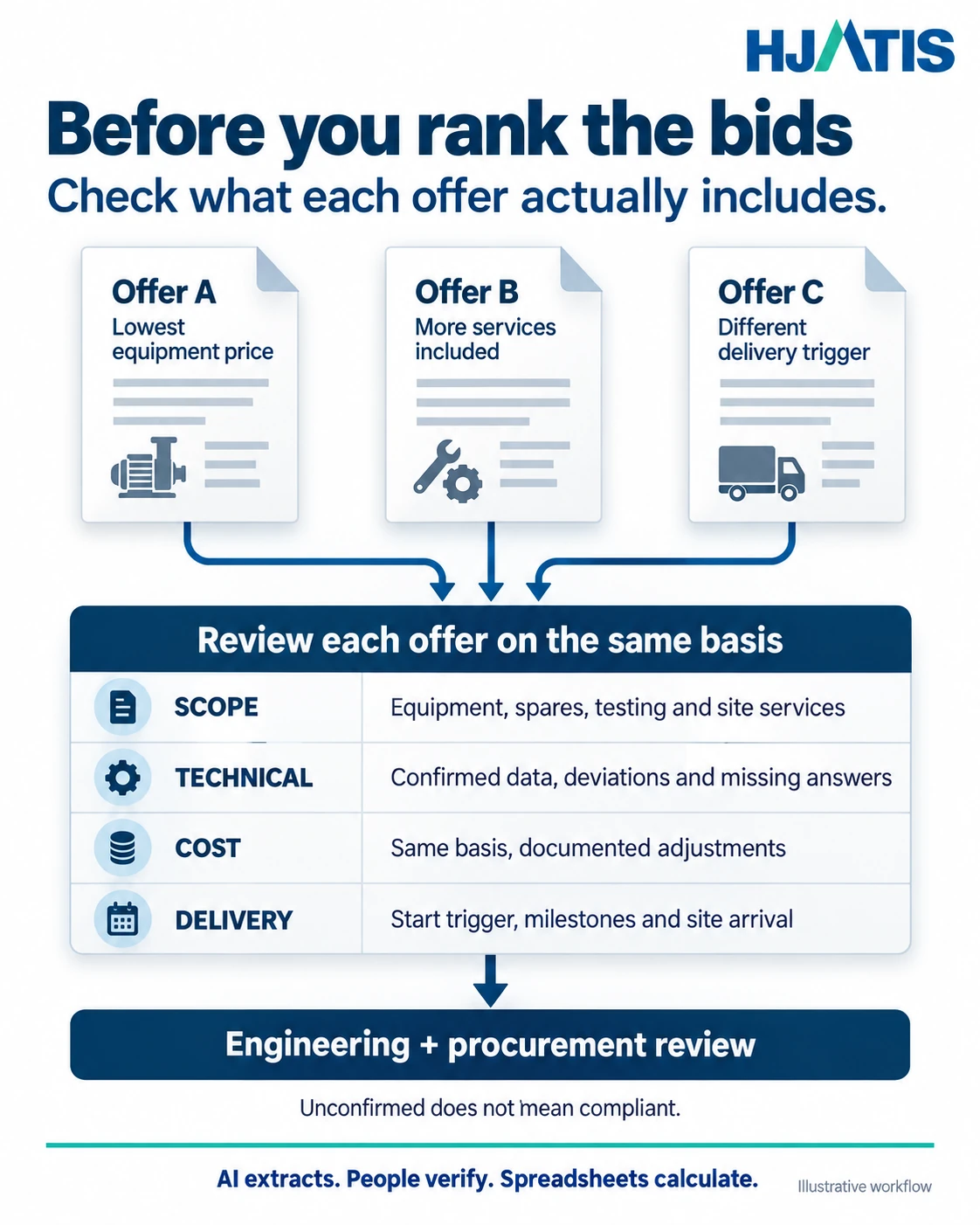
Offer A has the lowest equipment price but leaves some testing and site services unpriced. Offer B includes more of that scope. Offer C promises a shorter manufacturing period, counted from approved drawings and receipt of the advance payment.
Which offer is cheapest? I would first want to know what each price covers and when the equipment can actually reach site.
That is a useful starting point for AI in EPC procurement: finding the differences that deserve attention before the team negotiates or recommends an award. Here is how I would approach it for switchgear, transformers and E-house packages.
1. Set up the package before asking for prices
Start with the required site date and work backwards through shipping, inspections, manufacturing, drawing approval and supplier selection. Include the assumptions behind each duration and the dependencies between packages.
Transformer data may be needed for protection coordination. Equipment dimensions affect building layouts. Cable entries and auxiliary systems need agreement before an E-house design can be approved.
AI can extract these dates and dependencies from the project documents. The team still has to check them with the responsible engineers and suppliers. Manufacturing capacity, transport availability and a credible delivery commitment require direct verification.
The RFQ should give every bidder the same equipment schedule, document revisions, scope boundaries, return documents and pricing format. Ask for explicit exclusions and deviations. Ask suppliers to acknowledge each amendment. A revised price attached to an old technical offer can leave important changes unanswered.
2. Keep missing information visible
A useful technical comparison records the requirement, supplier response, source document and revision, unresolved question and responsible reviewer.
Ask the AI to extract the quoted response and its page or table reference. Then check those references against the originals, especially for scanned drawings and schedules. A confident summary is not a substitute for a readable source.
If the offer does not confirm a requirement, keep the status as "not confirmed." A catalogue for a similar product cannot establish that the offered configuration complies.
An unapproved short-circuit rating, protection arrangement or service condition needs an engineering decision. It should not disappear into a commercial adjustment simply because the offer is cheaper.
3. Build the cost comparison in a spreadsheet
Once the technical position is understood, put the offers on a common commercial basis: quantities, currency and exchange-rate date, named delivery point, freight, insurance, applicable duties and non-recoverable taxes, testing, spares and site services.
Check what is already included before adding an adjustment. Otherwise, the comparison can count freight or commissioning twice.
AI can flag differences and propose entries. Use checked spreadsheet formulas for the arithmetic. Every adjustment needs a documented basis, such as an additional quotation or an approved estimating assumption. Keep estimates distinguishable from firm prices.
A missing item is not automatically permission to repair a bid after submission. Clarifications, acceptable deviations and price adjustments must follow the applicable tender rules. The World Bank's guidance on rated criteria is useful context for evaluating quality and cost together; it is not a universal scoring system for every EPC purchase.
4. Turn the findings into purchasing options
A better comparison should lead to specific commercial actions.
First, look for duplicated scope. Cable terminations, auxiliary equipment or commissioning support may appear in both the equipment package and a site subcontract. Confirm who supplies and performs each item before removing an allowance.
Second, consider standardization or alternative configurations that engineering and the owner can approve. Common components may simplify purchasing and spares. Required performance, protection and operating conditions remain the starting point.
Third, compare package strategies. Buying switchgear, transformers and an E-house together can reduce coordination work. Separate sourcing may widen competition or provide access to a particular manufacturer. Include the additional engineering, logistics, testing and site work each option leaves with the EPC contractor.
AI can organize these options. Current prices and available production slots need supplier confirmation, not a model's estimate.
5. Clarify the dates before negotiating the headline price
"Delivery in 28 weeks" needs a start trigger and an endpoint. Does the clock start at purchase order, advance payment or approved drawings? Does it end at factory readiness, shipment or site arrival?
Three questions I would send back with the comparison are:
- Which RFQ revisions does this offer cover, and what deviations or exclusions remain?
- Who supplies, installs and tests each connection between equipment packages, including auxiliaries and external connections?
- What are the delivery trigger, approval assumptions and committed dates for drawings, FAT, shipment and arrival?
Check the answers against the project programme. A short manufacturing period may still leave the equipment arriving after the required site date.
6. Carry the agreed scope into the order
The award recommendation and order documents should preserve the agreed equipment list, accepted deviations, clarification responses, document revisions, price breakdown and delivery commitments.
Turn those commitments into a register of drawing submissions, approvals, inspections, factory acceptance testing, shipping documents and delivery dates. AI can compare updates with that register and flag missing reports. Verified production progress and intervention remain the project team's responsibility.
I would also keep four measures separate: reduced EPC expenditure, staff time saved, costs potentially avoided and the owner's operating costs. Lower transformer losses may benefit the owner over many years; they are not automatically an immediate saving in the EPC purchasing budget. Staff time saved must include the time spent checking and correcting AI output.
Finally, use a company-approved AI workspace and respect bid confidentiality. Do not upload rival quotations, internal budgets or evaluation records to a supplier-operated tool without authorization. Engineering and procurement should sign off the recommendation under the project's approval process.
For me, the useful test is whether the team can explain what it is buying, what is still unresolved and what the supplier has committed to deliver. That makes a procurement decision easier to review and defend.
Discuss an electrical equipment package
I am with HJATIS. For a project discussion, email fanos@hjatis-switchgear.com with the project location, equipment scope and required site date. A single-line diagram or equipment list you are authorized to share can help establish the next technical questions.
Company and equipment information: hjatis-power.com
Related buyer notes on quotations, FAT and delivery: HJATIS technical library
The opening offers are hypothetical. The illustrations are conceptual and do not depict an actual tender or customer project.
Sources and further reading
Read these publications alongside the project specifications and the documents for the equipment offered.
LinkedIn — original article by Fanos ↗World Bank — rated criteria ↗Procurement guidance. The project engineer and equipment manufacturer must confirm the final design and acceptance criteria.